

After this I looked, and there before me was a door standing open in heaven. And the voice I had first heard speaking to me like a trumpet said, “Come up here, and I will show you what must take place after this.” At once I was in the Spirit, and there before me was a throne in heaven with someone sitting on it. (Revelation 4:1, 2, NIV 1984)
My Musings – The opening verses of this chapter of Revelation beg three questions.
The first question is: after what? The simplest and perhaps the most logical answer would be after John had finished taking down dictation for the letters to the seven churches. But, as noted before, some Bible scholars believe that these churches were a prophetic panorama of the different phases of Church history extending from apostolic times until the end of the age. Each of the seven churches would thus represent major periods that the universal Church would go through before Christ’s return. By way of review, these periods are summarized below.
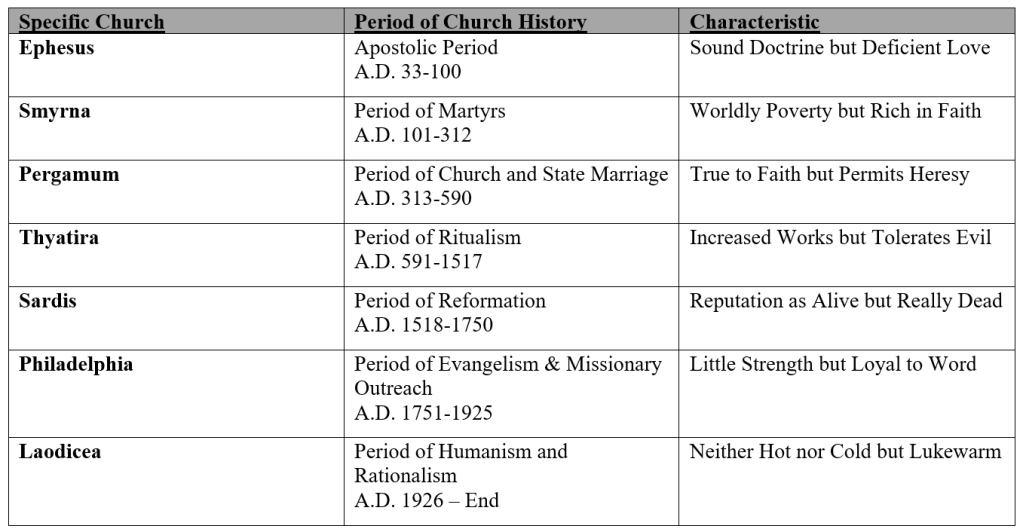
Under this interpretation, “after this” could refer to after the totality of the Church age that the seven churches represent. John is commanded to “come up here,” (Heaven) so he can be shown what will happen afterwards, which he proceeds to record in the remaining pages of Revelation. Some believe that this command is also a veiled reference of the future rapture of the Church. Since this happens before John is shown any future events it is viewed as further evidence that the Church will not go through the tribulation (pretribulationalism).
Those holding this view are quick to point out that the Church is mentioned nineteen times in the first three chapters of Revelation, but not once in chapters four through nineteen, where God is pouring out His wrath upon the earth. Thus, under this view “what must take place after this” (Revelation 5-9:16 – the Tribulation) occurs after the Church age and the rapture.
Some commentators see the destruction of the earth by flood and the destruction of Sodom and Gomorrah as “types” of the rapture and provide a pattern or precedence for a pretribulation rapture viewpoint.

Other images that some see as representing the rapture in this passage include (emphasis added):
- Voice Like a Trumpet – For the Lord himself will come down from heaven, with a loud command, with the voice of the archangel and with the trumpet call of God, and the dead in Christ will rise first (1 Thessalonians 4:16, NIV 1984).
- Come Up Here –After that, we who are still alive and are left will be caught up together with them in the clouds to meet the Lord in the air. And so we will be with the Lord forever (1 Thessalonians 4:17, NIV 1984).
- At Once in the Spirit – Listen, I tell you a mystery: We will not all sleep, but we will all be changed—in a flash, in the twinkling of an eye, at the last trumpet. For the trumpet will sound, the dead will be raised imperishable, and we will be changed. For the perishable must clothe itself with the imperishable, and the mortal with immortality (1 Corinthians 15:51-53).
Other commentators advance some equally compelling arguments to suggest that the rapture will not occur until after the tribulation, meaning that the Church would go through the tribulation.
- Sake of The Elect – In the Olivet Discourse, Jesus states: “but for the sake of the elect those days will be shortened (Matthew 24:22, NIV 1984).” These commentators believe that the elect refers to Church age saints and Tribulation saints and not just Tribulation saints.
- The Last Trumpet – In 1 Corinthians 15:52 Paul states that the Rapture will occur “at the last trumpet.” These commentators believe that this refers to the seventh trumpet judgment (Revelation 11:15) and that it will occur towards the end of the Tribulation.
- Plagues on Egypt – This argument is set in opposition to the days of Noah and Sodom and Gomorrah “types.” These commentators point out that the Hebrew children were not removed before the plagues but rather were protected from the plagues.
This brings us to the second question. How long “after this” would the things shown to John take place? Revelation 4 does not specifically answer this question. Rather, one must go back to Revelation 1:1 for the answer: “The revelation of Jesus Christ, which God gave him to show his servants what must soon take place.” The Greek word translated as soon means that the action will be sudden when it comes, not necessarily that it will occur immediately. In other words, once the end-time events begin (which could be near term or distant future), the events will occur in rapid succession.
The third question is who is the “someone” sitting on the throne? If not immediately clear (who else might be sitting on God’s throne?). Stay tuned.
My Advice – The “door” to Heaven remains open to this day. Until it is closed, there are things that “must take place.” But their is only one important thing that must happen to allow one to “come up here,” be it through death, rapture or parousia. Jesus said, “I tell you the truth, no one can enter the kingdom of God unless he is born of water and the Spirit. Flesh gives birth to flesh, but the Spirit gives birth to spirit. You should not be surprised at my saying; you must be born again.” (John 3:5–7, NIV 1984). Must is an imperative. Death offers no second chance to those not born again. To live through the tribulation may offer a “second” chance. But there is no guarantee that those who do not respond to God’s grace will respond to His wrath. For that reason, “I tell you, now is the time of God’s favor, now is the day of salvation.” (2 Corinthians 6:2, NIV 1984).
Resources:
Walvoord, John F. (1985). Revelation. In J. F. Walvoord & R. B. Zuck (Eds.), The Bible Knowledge Commentary: An Exposition of the Scriptures (Vol. 2, p. 928). Wheaton, IL: Victor Books.
Wiersbe, W. W. (1992). Wiersbe’s expository outlines on the New Testament (pp. 798 & 806). Wheaton, IL: Victor Books.
Lindsey, Hal (1973). There’s A New World Coming. New York: Bantam Books.

 The Brew Is A Musing