

And I saw the seven angels who stand before God, and to them were given seven trumpets. Then the seven angels who had the seven trumpets prepared to sound them. (Revelation 8:2, 6, NIV 1984).
My Musings – Only two angels are specifically named in the canonical scripture (Michael and Gabriel). The Apocrypha (Enoch 20:7) names seven archangels (Uriel, Raphael, Raguel, Michael, Sariel, Gabriel, Remiel). In the period between the Old Testament and the New Testament Judaism had commonly accepted that there were seven archangels (adding the five to the two others).According to Numbers 10, trumpets had three important uses.
- Call to Assembly – They called the people to assemble. “The Lord said to Moses: ‘Make two trumpets of hammered silver and use them for calling the community together and for having the camps set out. When both are sounded, the whole community is to assemble before you at the entrance to the Tent of Meeting. If only one is sounded, the leaders—the heads of the clans of Israel—are to assemble before you.” (Numbers 10:1–4, NIV 1984).
- Call to Battle – They proclaimed war and battles. “When you go into battle in your own land against an enemy who is oppressing you, sound a blast on the trumpets. Then you will be remembered by the Lord your God and rescued from your enemies.” (Numbers 10:9, NIV 1984).
- Call for Special Events – They announced special events and occasions. “Also, at your times of rejoicing—your appointed feasts and New Moon festivals—you are to sound the trumpets over your burnt offerings and fellowship offerings, and they will be a memorial for you before your God. I am the Lord your God.” (Numbers 10:10, NIV 1984).
Seven trumpets are not unique to the book of Revelation. Commentators note that a series of seven trumpeters appeared in the Old Testament (conquest of Jericho, Joshua 6:6; return of the Ark to Jerusalem, 1 Chronicles 15:24; dedication of rebuilt Jerusalem wall, Nehemiah 12:41). But the purpose of these seven trumpets is unique signaling additional judgments from God.
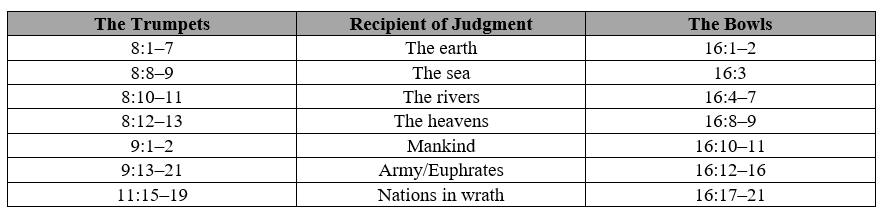
The first four trumpets in Revelation share a common feature in that their judgments affect natural objects, most of which are essential to sustaining life on the earth (trees, grass, sea, rivers, fountains, sun, moon, and stars). The last three trumpets (the so-called woe-trumpets) affect mankind’s life with pain, death, and hell.
In many respects, these trumpet judgments appear to parallel the plagues of Egypt. Five or six out of the ten plagues on Egypt correspond exactly to the trumpets: hail, fire (Exodus 9:24), water turned to blood (Exodus 7:19), darkness (Exodus 10:21), locusts (Exodus 10:12), and death (Revelation 9:18). Because of the sweeping scale of the trumpet judgments, some scholars question how these judgments could possibly be taken literally. But if God could send these same judgments specifically to Egypt in Moses’ day, what is to prevent Him from sending them upon the entire world? Is His reach restricted to one region of the globe? Is His reach limited in its scope? Cannot He who created all things exercise judgment on all things?
One can only begin to imagine the tremendous social, economic and life or death consequences from the loss of farm and pasture land and from the pollution of pure water. Mankind has never fully appreciated the blessings of God’s goodness in nature. Yet, even when He takes away some of those blessings, many sinners will still refuse to repent (Revelation 9:20–21).
There is also a parallel between the seven trumpets and the seven bowls of Revelation 15–16. It seems that the seven bowls are intensified trumpet judgments. It is possible that the trumpet judgments belong to the first three and one-half years of the tribulation, while the bowls are poured out during the last three and one-half years, when God’s wrath is intensified. The second half of the tribulation (the great tribulation) is referred to as “the wrath of God” (Revelation 14:10; 15:7). And there is no denying that this is the unleashing of God’s wrath, as the judgments of come straight from the throne of God.
Insurance policies euphemistically (agreeable or inoffensive expression for something unpleasant) refer to “acts of God,” but the extreme unpleasantness of “the wrath of God” when it is finally unleashed will be more than merely unpleasant.
My Advice – Pray that family and friends will be spared this horror. Share when you can. It may become unpleasant at times and strain the relationship, but they pale in comparison to the wrath to come.
Sources:
Robertson, A. T. (1933). Word Pictures in the New Testament (Re 8:2). Nashville, TN: Broadman Press.
Keener, C. S. (1993). The IVP Bible background commentary: New Testament (Re 8:2). Downers Grove, IL: InterVarsity Press.
Wiersbe, W. W. (1996). The Bible exposition commentary (Vol. 2, p. 592). Wheaton, IL: Victor Books.
Jamieson, R., Fausset, A. R., & Brown, D. (1997). Commentary Critical and Explanatory on the Whole Bible (Vol. 2, p. 571). Oak Harbor, WA: Logos Research Systems, Inc.
Wiersbe, W. W. (1992). Wiersbe’s expository outlines on the New Testament (p. 818-820). Wheaton, IL: Victor Books.

 The Brew Is A Musing