

And I saw a beast coming out of the sea. (Revelation 13:1b, NIV 1984).
My Musings – “The beast, which you saw, once was, now is not, and will come up out of the Abyss and go to his destruction.” (Revelation 17:8, NIV 1984).
The word anti-Christ occurs only four times in the Bible. All occurrences are in John’s epistles (1 John 2:18, 22; 4:3; 2 John 7), none are in Revelation. 1 John 2:18 refers to “many anti-Christ’s.” John described any person or message that did not “confess Jesus” as being the spirit of the anti-Christ (1 John 4:3). In his Second Epistle, John referred to “many deceivers” who would not “acknowledge the coming of Jesus Christ in the flesh” (2 John 7). Such a person, he wrote, was “the deceiver and the anti-Christ.”
John warned that a final anti-Christ, who, like the others, would deny that Jesus is the Christ, would yet make an appearance. John apparently assumed that his Christian readers knew about the anti-Christ and had been taught to expect his coming (1 John 2:18–27). Throughout history, many possibilities have been suggested as to the identity of the anti-Christ, some of which are mentioned below. As they did not usher in the events prophesied by Daniel and by John, they could only be one of the many deceivers who “once were” that John spoke about, but not the one that “will come up out of the Abyss.”
Antiochus IV Epiphanes – Antiochus IV Epiphanes was one of the earliest candidates for an anti-Christ type (2nd century BC). He brought all the nations (in his part of the world) under his authority as one people (1 Maccabees 1:41–43) and demanded the worship normally considered due rulers in the East. Antiochus IV assigned himself the title Epiphanes, meaning God manifest.
Following the death of Alexander the Great, his kingdom was split between his generals, one of which was Seleucus I Nicator. He formed the Seleucid Empire, which included Babylonia. Antiochus IV ruled the Seleucid Empire from 175 to 164 BC after it had also gained control of Judaea from the Ptolemaic kingdom (largely Egypt). The Ptolemaic kingdom was named after Ptolemy I Soter, another general of Alexander the Great.
Known for his harshness, Antiochus IV sought to unify the diverse Seleucid territories by outlawing Judaism and instituting a shared culture of Hellenism in Judea and Jerusalem. Antiochus IV and his army attacked Jerusalem in 169 BC, with the resulting slaughter of many. Following this attack, Antiochus IV entered and looted the temple. Two years later Antiochus IV dispatched Apollonius, one of his officers, with 22,000 men. They attacked Jerusalem on the Sabbath, resulting in the death of much of the male population. All Jewish rights were banned, and the temple was rededicated to Zeus. Anyone found with a copy of the Torah, or any circumcised child was put to death.
In December of 167 BC, a sacrifice for Zeus was offered on the new altar in the temple. The great Maccabean revolt arose in reaction to this event – the first to be known as the “abomination of desolation” (Daniel 11:31; 12:11; 1 Maccabees 1:54). The word abomination denoted pagan idolatry and its detestable practices (Deuteronomy 29:16–18; 2 Kings 16:3–4; 23:12–14; Ezekiel 8:9–18). The phrase “the abomination of desolation” referred to the presence of an idolatrous person or object so detestable that it caused the temple to be abandoned and left desolate.
Nero Caesar – Nero (54–68 AD) was the first of two Roman emperors that were especially noted for their harsh treatment of Christians. Domitian (81–96 AD) was the second. Nero attributed the great fire in Rome to the Christians and persecuted them violently in the city of Rome itself. Domitian is also reported to have violently persecuted Christians, though the evidence for this has been disputed by some. Most scholars think that the book of Revelation was written during the reign of either Nero or Domitian.
Many in the first century considered Nero to be the anti-Christ. Subsequent scholars holding to the preterist view do as well, concluding that John wrote Revelation during Nero’s reign. Writing from Roman captivity on the Island of Patmos they assert that he used its apocalyptic language as a code, knowing that his Jewish Christian readers would readily understand it, but that his Roman captors would not. For obvious reasons, as a prisoner of Rome it is unlikely that John would come right out and write anything negative about the Emperor or the Government that held him captive. Thus, if he wanted to let Christians know that “the Beast” was the Emperor Nero, he might say: “Here is wisdom. Let him who has understanding calculate the number of the beast, for the number is that of a man; and his number is six hundred and sixty-six” (Revelation 13:18).
The Hebrew spelling of Nero Caesar was NRWN QSR. Since Hebrew letters doubled as numbers it was a simple thing to take that name and add them together which adds up exactly to 666 (Example: N = 50 R = 200 W = 6 N =50 Q = 100 S = 60 R = 200). Some manuscripts read 616 rather than 666. Why? Because when Revelation was later copied into Latin the name Nero Caesar didn’t add up to 666, it added up to 616. So, to make it easier for those later Latin-speaking (non-Hebrew reading) Christians to arrive at the same conclusion the number was changed to 616 in certain translations, or so the reasoning goes.
The Nero theory harmonizes nicely with the Olivet Discourse (“this generation shall not pass away”), assuming that John was incarcerated on Patmos during this period. The reference in Revelation 17:10 to “seven kings,” of whom “five have fallen, one is, and the other has not yet come,” also fits well with this dating. Nero was sixth in the line of Roman emperors. Five had fallen (Julius, Augustus, Tiberius, Caligula, Claudius), one is (Nero), and the other has not yet come (one of the successive Caesars or perhaps a far future, end-times anti-Christ?).
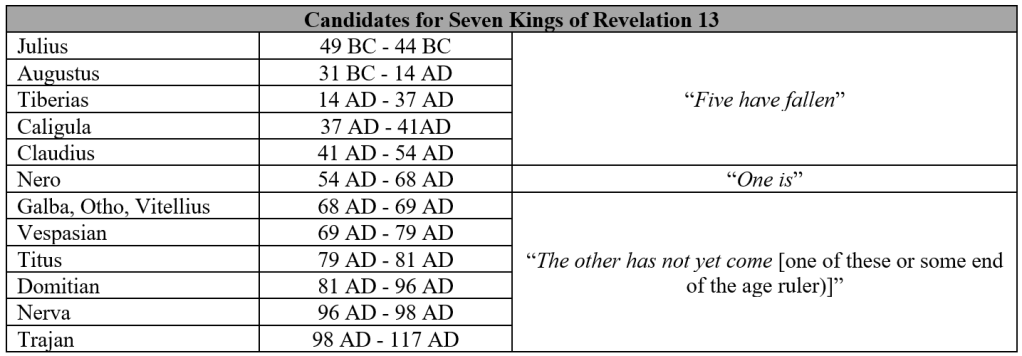
Note: While Julius Caesar had imperial powers, he never held the title of emperor. Rome had been a republic for almost 500 years. Its citizens hated the idea of a monarch, and Julius Caesar judiciously declined the title, accepting a republican office instead. Nevertheless, he ruled as a virtual dictator from 49 BC to 44 BC. The republic was dead in practice if not in principle. Vainly hoping to revive the republic, and fearing Caesar’s imperial ambitions, a group of republicans conspired to assassinate him. Caesar was murdered on March 15 (the “Ides of March”), 44 BC, as he entered the Roman Senate. Although the conspiracy succeeded, its purpose failed. In the civil war that followed, Caesar’s nephew Octavian (Augustus) emerged as victor and in 31 BC became the first “official” Roman emperor.
Although Nero died (reportedly by his own hand) on June 9, 68 AD, rumors circulated that he was still alive and ready to take vengeance on the Roman aristocracy for rejecting him. According to writers of the day, most people in the eastern part of the Empire expected his return (“once was, now is not, and will come up,” the so-called Nero redivivus myth). Several impostors arose claiming to be Nero, hoping to gather followings in the eastern Empire, where he was most popular.
One of them arose in Asia Minor during the reign of Titus (Domitian’s older brother). During Domitian’s reign, a Nero figure even persuaded the Parthians to follow him to invade the Roman Empire, but Domitian forced them to back down and executed the impostor instead. Jewish oracles predicted the return of Nero, and Christians feared it. This fear so shaped the views of early Christians—thousands of whose numbers had been eradicated under Nero in Rome—that Nero even became a term for anti-Christ in the Armenian language. Many later Christian writers, including Tertullian, Augustine and Jerome, connected Nero with the anti-Christ.
Vespasian – From 66–73 AD, Jewish forces waged the Jewish War (or the First Jewish Revolt). Rebel forces captured Masada and the Antonia fortress, as well as the temple. In response, Nero dispatched the Roman general Vespasian to suppress the uprising in 67 AD. Following a year of unsettlement after Nero’s death (68 AD), Vespasian emerged as the next emperor. He returned to Rome and left the task of ending the Jewish revolt to his son Titus. Thus, the siege of Jerusalem that was begun by Vespasian in 69 AD, culminated with the destruction of the city and the burning of the temple in 70 AD by Titus. According to the Jewish historian Josephus, Titus sought to avoid destroying the temple, but because of the Jews’ persistent resistance, he was forced to set the gates on fire to gain entrance. The Jews continued their fight against the soldiers ordered to extinguish the fire and the fire spread.
In His Olivet Discourse Jesus used the phrase “abomination of desolation” in answering the disciples’ questions concerning the destruction of the temple and the general course of the age until his return (Matthew 24:1–31; Mark 13:1–27; Luke 21:5–28). In alluding to the Daniel passages, Jesus predicted that something analogous to the destruction by Antiochus IV would reoccur. Jesus applied the prediction and fulfillment of Daniel’s prophecy in part to the coming Roman desecration which did in fact take place in 70 AD.
Thousands of Jews starved to death during the siege of Jerusalem. Josephus, who lived through the war of 66–70 AD, claimed that 1,100,000 Jews died in the siege (Josephus, Bellum Judaicum, 6.9.3). Josephus also believed that the “abomination of desolation” (the reference is to Daniel 9:27; 11:31; 12:11) happened in 66 AD when Zealots shed the blood of priests in the temple. Others date the “abomination of desolation” three and one-half years later (an interesting interval), in 70 AD. The Jews considered it a sacrilege for the Roman standards, which bore the image of the worshiped emperor, to enter Jerusalem. But in 70 AD, when the temple was actually destroyed, the Romans erected these same standards over the desolated site of the temple. Both views may be true: if the phrase means “abomination that causes desolation,” then the abomination of 66 AD may have eventually led to the desolation of 70 AD.
To misquote John the Baptist, “were one of these the one, or should we expect another?” The Apostle John said there were (would be) many anti-Christ’s in the world, so it is possible, perhaps most likely, the one to come is yet to come. Thus, the events surrounding the earlier candidates (Antiochus Epiphanes, Nero, and Vespasian) would be types that foreshadow the final fulfillment of Jesus’ words just prior to His Second Advent (Mark 13:24–27). Language used by Mark in his Gospel suggests that “the abomination” is a future person “standing where he does not belong.” This person could be the end-time anti-Christ mentioned in a variety of texts (Daniel 7:23–26; 9:25–27; 2 Thessalonians 2:3–4, 8–9; Revelation 13:1–10, 14–15).
As some interpret Daniel 9:27, this end time anti-Christ “will confirm a covenant with many [the Jewish people] for one seven,” the beginning of the seven-year period preceding Christ’s second coming. The temple will be rebuilt, and worship reestablished (Revelation 11:1 – the measuring of the temple). “In the middle of the seven” (after 3½ years), the anti-Christ will break his covenant, stop the temple sacrifices, desecrate the temple (Daniel 9:27), and proclaim himself to be God (Matthew 24:15; 2 Thessalonians 2:3–4; Revelation 11:2). This launches the terrible end-time events of the great tribulation (Revelation 6; 8–9; 16). Those who refuse to be identified with the anti-Christ will suffer severe persecution and be forced to flee for refuge (Revelation 12:6, 13–17). Many—both Jews and Gentiles—will be saved during this period (Revelation 7) but many will also be martyred (Revelation 6:9–11).
My Advice – There will be many. Reject them all, especially the last one.
Resources:
Elwell, W. A., & Beitzel, B. J. (1988). In Baker encyclopedia of the Bible (pp. 118–119). Grand Rapids, MI: Baker Book House.
Keener, C. S. (1993). The IVP Bible background commentary: New Testament (Re 13:1-10). Downers Grove, IL: InterVarsity Press.
Zacharias, H. D. (2012, 2013, 2014). Antiochus IV Epiphanes. In J. D. Barry, L. Wentz, D. Mangum, C. Sinclair-Wolcott, R. Klippenstein, D. Bomar, … D. R. Brown (Eds.), The Lexham Bible Dictionary. Bellingham, WA: Lexham Press.
Grassmick, J. D. (1985). Mark. In J. F. Walvoord & R. B. Zuck (Eds.), The Bible Knowledge Commentary: An Exposition of the Scriptures (Vol. 2, p. 169-170). Wheaton, IL: Victor Books.
Jones, D. L., & Powell, M. A. (2011). emperor. In M. A. Powell (Ed.), The HarperCollins Bible Dictionary (Revised and Updated) (Third Edition., p. 239). New York: HarperCollins.
Elwell, W. A., & Beitzel, B. J. (1988). In Baker encyclopedia of the Bible (p. 10). Grand Rapids, MI: Baker Book House.
Melvin, D. P. (2012, 2013, 2014). History of Israel, Post-monarchic Period. In J. D. Barry, L. Wentz, D. Mangum, C. Sinclair-Wolcott, R. Klippenstein, D. Bomar, … D. R. Brown (Eds.), The Lexham Bible Dictionary. Bellingham, WA: Lexham Press.
Garbarino, C. (2012, 2013, 2014). Emperor Titus. In J. D. Barry, L. Wentz, D. Mangum, C. Sinclair-Wolcott, R. Klippenstein, D. Bomar, … D. R. Brown (Eds.), The Lexham Bible Dictionary. Bellingham, WA: Lexham Press.
Keener, C. S. (1993). The IVP Bible background commentary: New Testament (Mk 13:14). Downers Grove, IL: InterVarsity Press.
Achtemeier, P. J., Harper & Row and Society of Biblical Literature. (1985). In Harper’s Bible dictionary (1st ed., p. 148). San Francisco: Harper & Row.
Sloan, R. B. (1998). The Revelation. In D. S. Dockery (Ed.), Holman concise Bible commentary (p. 661). Nashville, TN: Broadman & Holman Publishers.
Elwell, W. A., & Beitzel, B. J. (1988). In Baker encyclopedia of the Bible (p. 392). Grand Rapids, MI: Baker Book House.
Mark Giles, http://subversive1.blogspot.com/2014/10/the-mark-of-beast-revealed.html
Wiersbe, W. W. (1996). The Bible exposition commentary (Vol. 2, pp. 604–605). Wheaton, IL: Victor Books.
 The Brew Is A Musing