

They came to life and reigned with Christ a thousand years. (Revelation 20:4b, NIV 1984).
My Musings – The word millennium is derived from the Latin words mille meaning a thousand, and annus meaning year, or a period of one thousand years. Although the concept of the millennium has its foundation in certain unconditional covenants in the Old Testament, Revelation 20:4–6 specifically mentions that Christ will reign on earth for a thousand years following His return to earth.
While it is true that Revelation 20:1–6 is the only passage that mentions the specific period of one thousand years, it does so six times, and repetition is always significant in the Bible. During this time, Satan is imprisoned in the Abyss and is unable to mislead the nations. The saints, meanwhile, reign with Christ. Three primary viewpoints on the nature of the millennium.
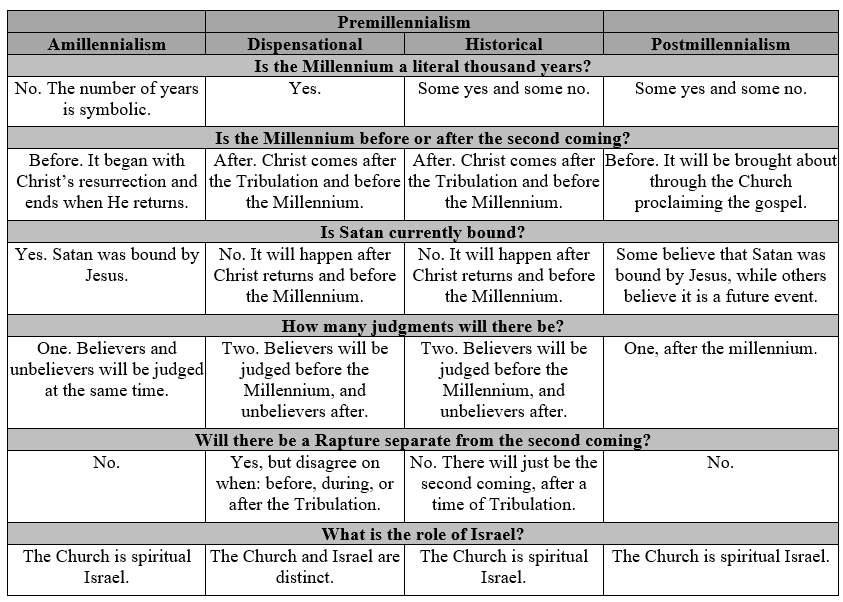
Amillennialism – Is to be commended for its emphasis upon the current reign of Jesus Christ. The Book of Revelation makes abundantly clear that Christ has already overcome, having been raised and exalted to the right hand of God. He is currently Lord of the Church and of the cosmos. God has “raised him from the dead and seated him at his right hand in the heavenly realms, far above all rule and authority, power and dominion, and every title that can be given, not only in the present age but also in the one to come.” (Ephesians 1:20–21, NIV 1984).
Premillennialism – Consistently interprets the teachings of Scripture in a plain, normal, or literal way, whether applied to history, doctrine, or prophecy. It is normally viewed as unwise to take the words of the Bible in a nonliteral sense, unless the context obviously calls for a metaphorical, allegorical or spiritualized interpretation. For example, promises that were made to Abraham and David concerned the physical descendants of Abraham. Why, unless by sleight of hand, would we expect them to be fulfilled by the Church? Since the New Testament continues to distinguish the Jews from the Church, it appears that we should expect these promises to be fulfilled through the Jews rather than through the Church. “I do not want you to be ignorant of this mystery, brothers, so that you may not be conceited: Israel has experienced a hardening in part until the full number of the Gentiles has come in. And so all Israel will be saved.” (Romans 11:25–26, NIV 1984).
Postmillennialism – Accurately captures a significant theme in Biblical prophecy that we must live and preach hope. We must preach the Gospel to the ends of the earth in the expectation and belief that God will somehow use our witness to increase His Kingdom and that He will ultimately triumph over Satan and his demons. Though we certainly cannot bring the Kingdom of God on earth through human means, the preaching of the Gospel does indeed offer hope for the transformation of life. “It is not for you to know the times or dates the Father has set by his own authority. But you will receive power when the Holy Spirit comes on you; and you will be my witnesses in Jerusalem, and in all Judea and Samaria, and to the ends of the earth.” (Acts 1:7–8, NIV 1984).
My Advice – The debate over a, pre, or postmillennialism can sometimes obscure a crucial point that concerned John very much. Followers of Christ, those who have suffered the afflictions and persecutions of this present evil age, will one day be rescued and vindicated by the appearance of Christ. With His coming He will destroy the powers of evil. The promise of this future hope should exert an influence upon our present behavior and moral devotion to Christ. A major point of Revelation is to encourage Christian perseverance in the present age in light of the triumph of God through Jesus Christ in the coming age. So let’s make sure we don’t strain so hard at the gnat that we swallow the camel.
Resources:
- Enns, P. P. (1989). The Moody handbook of theology (p. 641). Chicago, IL: Moody Press.
- Sloan, R. B. (1998). The Revelation. In D. S. Dockery (Ed.), Holman concise Bible commentary (pp. 678–679). Nashville, TN: Broadman & Holman Publishers.
- Barry, J. D., Heiser, M. S., Custis, M., Mangum, D., & Whitehead, M. M. (2012). Faithlife Study Bible. Bellingham, WA: Logos Bible Software.
- Dockery, D. S., Butler, T. C., Church, C. L., Scott, L. L., Ellis Smith, M. A., White, J. E., & Holman Bible Publishers (Nashville, T. . (1992). Holman Bible Handbook (p. 803). Nashville, TN: Holman Bible Publishers.
- Ryrie, C. C. (1972). A survey of Bible doctrine. Chicago: Moody Press.
 The Brew Is A Musing