

I saw heaven standing open and there before me was a white horse…With justice he judges and makes war. His eyes are like blazing fire, and on his head are many crowns. He is dressed in a robe dipped in blood. The armies of heaven were following him, riding on white horses and dressed in fine linen, white and clean. Out of his mouth comes a sharp sword with which to strike down the nations. “He will rule them with an iron scepter.” He treads the winepress of the fury of the wrath of God Almighty. (Revelation 19:11-16, NIV 1984).
My Musings – Christ is riding a white horse to make war with the beast and execute judgment on mankind. Contrast this with His triumphant entrance into Jerusalem in Matthew 21:1–7), “gentle and riding on a donkey.” as the Prince of Peace. When the course of history sinks to its lowest point, Christ will return to judge the world in vengeance, rescue His saints and establish His kingdom on earth. Because His victory is certain, He is able to ride the white horse into battle, rather than waiting until the battle is won. Such a display would be presumptuous of anyone other than the King of king and Lord of lords.
This description of Christ on a white charger should thrill us.
His Eyes – His eyes are not filled with tears, as when He beheld and wept over Jerusalem. Rather “His eyes are like blazing fire” symbolizing His searching judgment that sees all (Revelation 1:14).
His Crown –He is not wearing a crown of thorns. Instead “on His head are many crowns.” The “many crowns” (diadems) indicate His magnificent rule and sovereignty.
His Raiment – Instead of being stripped by His enemies, “He is dressed in a robe dipped in blood.” The “robe dipped in blood” speaks of judgment and probably relates to the conquest of His enemies (Isaiah 63:1–6 and Revelation 14:20). This time it is not His blood that marks His clothes, but that of His foes.
His Weapon – His mouth does not speak words of grace (Luke 4:22), but rather the Word “out of his mouth is a sharp sword with which to strike down the nations.” The “sharp sword” is a symbol of God’s Word (Ephesians 6:17; Hebrews 4:12; Revelation 1:16). This is in keeping with the fact that Christ will consume the enemy “with the spirit of His mouth” (2 Thessalonians 2:8; note also Isaiah 11:4).
His Scepter – He comes to rule with “an iron scepter” (Psalm 2), not a shepherd’s staff. We have seen the “iron scepter” before (Revelation 2:27; 12:5) as a symbol of His justice as He rules over the earth. The image of “He treads the winepress of the fury of the wrath of God Almighty” must be associated with the judgment at Armageddon (Revelation 14:14–20; see also Isaiah 63:1–6).
The Armies of Heaven – When on earth, He was abandoned by His followers. Here “the armies of heaven were following” Him in conquest. At His trial, Christ said that the Father could send legions of angels to deliver Him; and here the Lord rides forth with “the armies of heaven.”
Certainly, the angels are a part of this army (Matthew 25:31; 2 Thessalonians 1:7). So are the saints (1 Thessalonians 3:13; 2 Thessalonians 1:10), which are comprised of the raptured Church and the martyrs of the great tribulation. Jude describes this same scene (Jude 14–15) in his epistle. Like the army of Jehosophat, it will be unnecessary for this army to fight. Christ Himself will defeat the enemy.
He is not coming to bear the wrath of God on the cross, rather to execute God’s wrath as “He treads the winepress of the fury of the wrath of God Almighty” at the battle of Armageddon. He is indeed the “King of Kings and Lord of Lords!”
Theologians almost universally recognize the Parousia (second coming) as a yet-future physical event, as affirmed in the various creeds throughout the history of the Church. Just as the first coming of Christ was literal and was fulfilled in history, so the second coming of Christ which is yet to come will be fulfilled in the same literal manner.
There is not, however, universal agreement on the timing of the rapture of the Church, as revealed in such major passages as 1 Thessalonians 4:13–18 and 1 Corinthians 15:51–58. Is fulfilled at the same time as the second coming of Christ to the earth (post-tribulation view), or as a separate event three and a half years or seven years before His formal second coming to the earth (mid-tribulation and pre-tribulation views).
Is it Christ who makes the U-turn after meeting the raptured saints in the air to take them back to Heaven, so they can return to earth together at the end of age? Or is it the saints who make the U-turn at an end of age rapture, meeting Christ in the air and immediately returning to earth with Him? The saints meet Him in the air and return with Christ. Those are certain. The timing is uncertain.
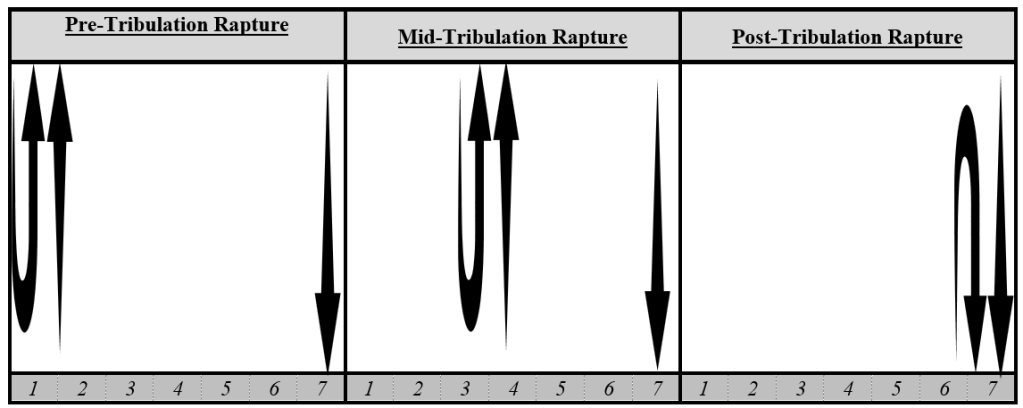
In Revelation, Christ definitely returns to the earth physically, while none of the so-called rapture passages appear to describe Him as coming to earth. Rather the saints meet Him in the air (1 Thessalonians 4:17).
In Revelation Chapters 19–20 there is no explicit mention of any rapture of living saints. If the rapture were included in the second coming of Christ to the earth, one would expect to find reference to such a major event in Revelation 19. But no such reference is to be found. In fact, the implication of the passage, is that saints who are still on earth when Christ returns will remain on earth to enter the Millennial Kingdom in their natural bodies (not the glorified body that happens in the twinkling of an eye in the rapture).
For these and many other reasons chapter 19 is viewed by many (but not all) as a confirmation of the teaching that the rapture of the Church is a separate earlier event and that there is no rapture of the living at the time of His second coming to the earth. Christ is not coming in the air to take His Church home (1 Thessalonians 4:13–18), but to the earth with His Church, to conquer His enemies and establish His Kingdom.
My Advice – For Christians, the timing of the rapture (removed before tribulation or protected through tribulation) should not be relevant. We shall reign with Him. That is promised. So don’t sweat the timing, rejoice in the certainty.
For unbelievers, the timing is also irrelevant. He is not coming to take you with Him, He is coming to judge in righteousness. So, don’t sweat the timing of what is coming, take time to now to seek the Lord while He may be found.
Resources:
Jamieson, R., Fausset, A. R., & Brown, D. (1997). Commentary Critical and Explanatory on the Whole Bible (Vol. 2, p. 596). Oak Harbor, WA: Logos Research Systems, Inc.
Wiersbe, W. W. (1992). Wiersbe’s expository outlines on the New Testament (pp. 850–851). Wheaton, IL: Victor Books.
Wiersbe, W. W. (1996). The Bible exposition commentary (Vol. 2, p. 617-619). Wheaton, IL: Victor Books.
Walvoord, John F. (1985). Revelation. In J. F. Walvoord & R. B. Zuck (Eds.), The Bible Knowledge Commentary: An Exposition of the Scriptures (Vol. 2, p. 976). Wheaton, IL: Victor Books.
 The Brew Is A Musing