

To the seven churches in the province of Asia: (Revelation 1:4a, NIV 1984)
My Musings – The immediate audience, of course, was the seven churches in Asia Minor (modern day Turkey).

The number seven was regarded by the Hebrews as a sacred number. Throughout Scripture it signified God’s covenant to mankind, especially to the Church. In the book of Revelation, the number seven is particularly prominent. In addition to the seven churches, there are seven spirits before the throne; seven golden candlesticks; seven stars in the right hand of Him who is like unto a son of man; seven lamps of fire burning before the throne; seven horns and seven eyes of the Lamb; seven seals of the book; seven thunders, seven heads of the great dragon and of the beast from the sea, seven angels with the trumpets, seven plagues, and seven mountains which are the seat of the mystic Babylon.
The book was originally sent to seven actual local churches in Asia Minor. But John makes it clear that “blessed are those who hear it and take to heart what is written in it.” (Revelation 1:3). The Apostle Paul sent letters to seven churches—Rome, Corinth, Galatia, Ephesus, Philippi, Colossae, and Thessalonica, and now John sends one book to seven churches as well.
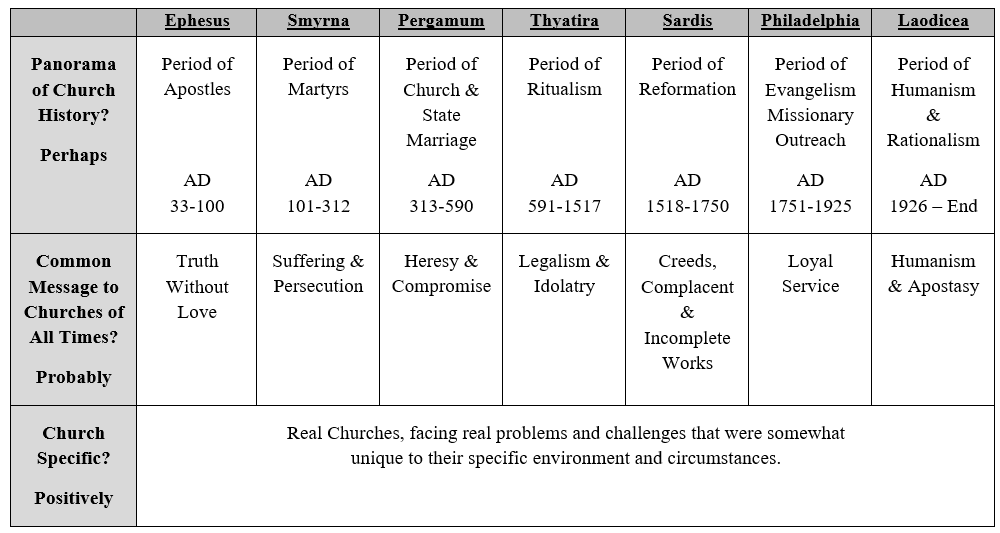
These were real churches facing real problems and challenges that were somewhat unique to their specific environment and circumstances. But why were these specific seven chosen? They were not the only churches in Asia (Colossae, Miletus, Hierapolis, or Magnesia). Why were the others excluded? Three possible reasons are typically given by the commentators.
- Message Specific to These Churches – Perhaps it was because the seven chosen were very influential and located on a well-known circular route. Additionally, their cities were centers of the imperial religion.
- Common Message for All Churches – Many commentators also see these particular churches as representative of the problems and challenges that churches in every age face. Their strengths and weaknesses are typical, and other churches can gain insight by studying Jesus’ message to them.
- Panorama of Church History –Others see the churches as representative of the different ages of church history, with the first, Ephesus, representing the apostolic church of the first century AD and the last, Laodicea, representing the increasingly humanistic church of our own day.
My Advice – Whichever view one holds, there are many insights we can gain and many warnings that we can heed. “Whoever has ears, let them hear what the Spirit says to the churches.” (Revelation 2:7, NIV 1984).
Sources:
Vincent, M. R. (1887). Word studies in the New Testament (Vol. 2, p. 411). New York: Charles Scribner’s Sons.
Wiersbe, W. W. (1996). The Bible exposition commentary (Vol. 2, p. 567). Wheaton, IL: Victor Books.
Barry, J. D., Heiser, M. S., Custis, M., Mangum, D., & Whitehead, M. M. (2012). Faithlife Study Bible (Re 1:4). Bellingham, WA: Logos Bible Software.
Richards, L., & Richards, L. O. (1987). The teacher’s commentary (p. 1071). Wheaton, IL: Victor Books.

 The Brew Is A Musing
Thanks for sharing this insight. It’s interesting how churches today still struggle with the same issues. People continue to be people across the ages, and the Bible is still as relevant today as the letters were when first written.
LikeLiked by 1 person
We need that relevance “all the more as we see the day approaching” and ears get more and more itchy to hear what is not the truth. Thanks for commenting and God’s blessings to you!
LikeLiked by 1 person